Emily Wilding Davison: Morpeth's Suffragette
The story of Emily Wilding Davison, the suffragette who gave her life for votes for women and whose grave at St Mary the Virgin in Morpeth remains a place of pilgrimage.
In the churchyard of St Mary the Virgin in Morpeth, a simple gravestone bears the inscription "Deeds not words." It marks the resting place of Emily Wilding Davison, teacher, scholar, and militant suffragette, who was fatally injured at the Epsom Derby on 4 June 1913 and died four days later. Her burial in Morpeth, her mother's home town, made this quiet Northumberland churchyard a site of national significance in the story of women's suffrage.
Early Life and Education
Emily Wilding Davison was born on 11 October 1872 in Blackheath, south-east London. She was an exceptional student. She won a bursary to Royal Holloway College, University of London, where she studied literature, and later attended St Hugh's College, Oxford, gaining a first-class result in her English finals, though Oxford did not award degrees to women at that time.
She took work as a teacher and governess to fund her studies, but her intellectual ambitions were repeatedly thwarted by the barriers placed before women in Edwardian Britain. It was this personal experience of injustice, combined with a fierce sense of principle, that drew her towards the suffrage movement.
Joining the WSPU
In November 1906, Emily joined the Women's Social and Political Union (WSPU), the organisation founded by Emmeline Pankhurst that advocated militant action, "deeds not words", to win the vote. She quickly became an officer and chief steward during marches.
Between 1906 and 1913, Davison threw herself into the campaign with extraordinary commitment. She was arrested nine times. Her offences included assaulting police during deputations to Parliament, breaking windows, setting fire to postboxes, and obstructing public meetings from which women were barred.
Prison, Hunger Strikes, and Force-Feeding
Emily went on hunger strike seven times during her periods of imprisonment, and she was force-fed on forty-nine occasions. The brutality of force-feeding, a tube forced through the nose or mouth into the stomach, was a deliberate policy to break the will of suffragette prisoners without creating martyrs through starvation.
Davison's response was characteristically defiant. On one occasion in Strangeways Prison, Manchester, she barricaded the door of her cell with furniture to prevent the force-feeding team from entering. A prison officer climbed a ladder and forced the nozzle of a hosepipe through the cell window, flooding the room with water. Davison later said she was prepared to drown rather than submit. The door was eventually broken down before the cell filled completely.
In another incident at Holloway Prison in 1911, she threw herself over a prison staircase railing, a fall of over thirty feet. She survived with serious spinal injuries, and later described the act as a protest against the "inhuman treatment" of suffragette prisoners.
Best for: Nine arrests, seven hunger strikes, forty-nine force-feedings, an extraordinary record of personal sacrifice.
The Epsom Derby, 4 June 1913
On 4 June 1913, Emily Wilding Davison travelled to Epsom for the Derby, the most prestigious flat race in the British calendar and an event guaranteed to attract public and press attention.
As the horses rounded Tattenham Corner, she stepped onto the track and was struck by Anmer, the horse owned by King George V. She was trampled and suffered a fractured skull. She never regained consciousness, and died in Epsom Cottage Hospital on 8 June 1913. She was forty years old.
Debate continues about her precise intentions. A return train ticket was found in her pocket, and she had been planning to attend a suffragette event that evening. Some historians believe she intended to attach a WSPU banner to the King's horse rather than to sacrifice herself. Whatever her intentions, the result was the same: her death made headlines around the world and galvanised the suffrage movement.
Funeral and Burial in Morpeth
The WSPU organised Emily's funeral on 14 June 1913. A procession of five thousand suffragettes and supporters walked with the coffin through the streets of London, watched by an estimated fifty thousand people. The coffin was draped in the WSPU colours of purple, white, and green.
From London, the coffin was taken by train to Morpeth, where Emily's mother Margaret had family connections. She was buried in the family plot at St Mary the Virgin Church. Her gravestone, paid for by suffragette supporters, reads:
"Deeds not words"
The Grave as a Place of Pilgrimage
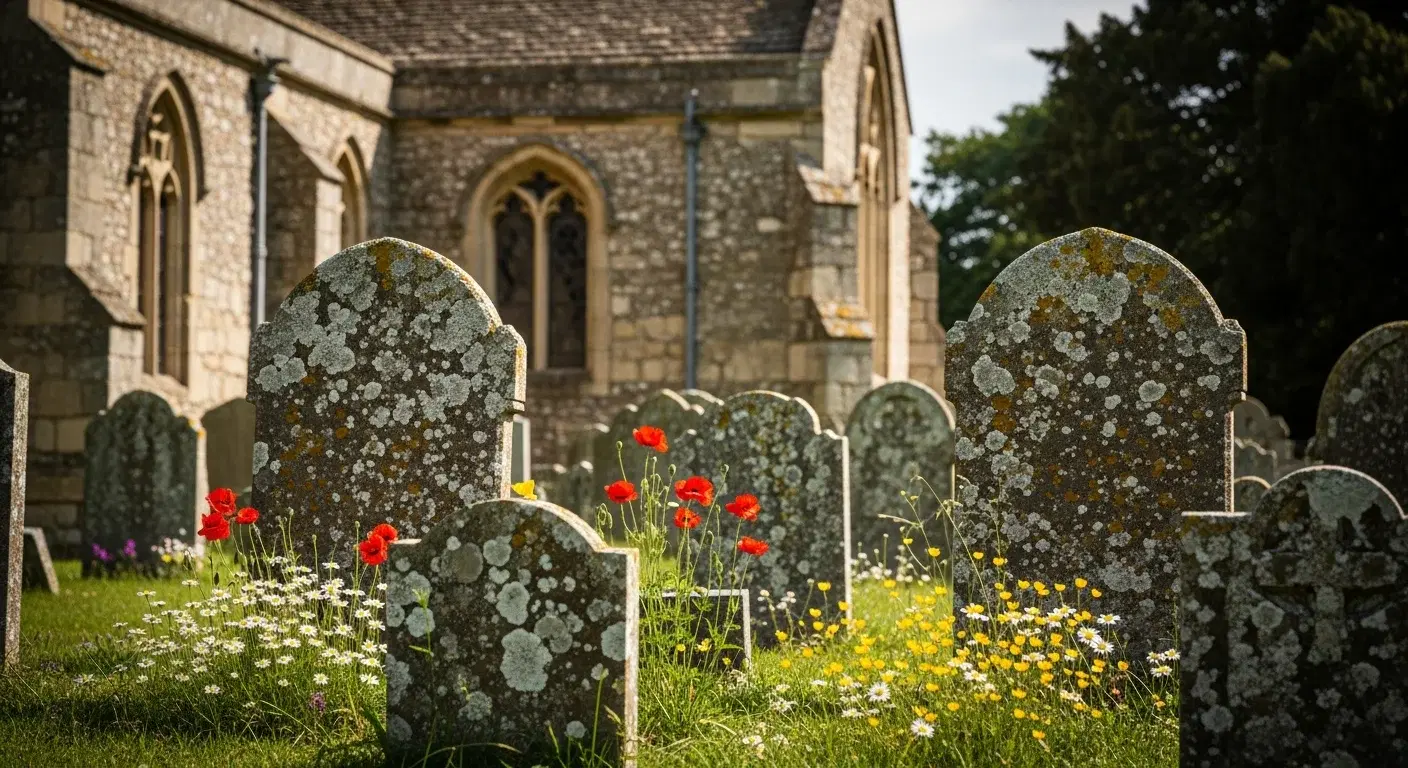
More than a century after her death, Emily's grave at St Mary's remains a site of pilgrimage. Visitors come from across the United Kingdom and beyond to pay their respects, often leaving flowers, suffragette-coloured ribbons, and messages of thanks.
The grave is easy to find. It is near the south wall of the churchyard, marked by a simple headstone. St Mary's itself is worth a visit: a fine 14th-century parish church with medieval stonework and an atmospheric interior.
The Ray Lonsdale Statue
On 11 September 2018, a bronze statue of Emily Wilding Davison by the North East sculptor Ray Lonsdale was unveiled in Carlisle Park by the Duchess of Northumberland. The ceremony marked the centenary of the Representation of the People Act 1918, which gave some women the vote for the first time.
The statue depicts Emily in a characteristic pose and stands near the formal gardens in the park. Together with the grave at St Mary's, it ensures that Morpeth's connection to the suffrage movement is visible and permanent.
Visiting
St Mary the Virgin Church is located on Church Lane, south of the town centre (approximately a ten-minute walk from Newgate Street). The churchyard is open at all times and the grave is freely accessible.
The Ray Lonsdale statue is in Carlisle Park, near the formal gardens on the south side of the park.
Both are free to visit and can easily be combined into a single walk, from the park, cross the river and follow the path south to the church.
Legacy
Emily Wilding Davison did not live to see women win the vote. The Representation of the People Act 1918 gave the franchise to women over thirty who met certain property qualifications. It was not until 1928, fifteen years after her death, that all women over twenty-one gained equal voting rights with men.
Her story remains a powerful reminder of what the right to vote cost, and of the extraordinary courage of those who fought for it. Morpeth is proud to be the town where she rests.
To find out more about Morpeth's heritage, get in touch.
Never miss what’s on
Join the weekly Morpeth.net digest — the best events, news and local tips, straight to your inbox. Free, one email a week.
What's On
Morpeth Wednesday Market
9:00am - 3:30pm · Market Place, Morpeth, NE61 1HG
October Quiz Night at Morpeth RFC
8:30 PM · Morpeth RFC, Grange House Fields, Mitford Road, Morpeth, NE61 1RJ
Halloween Spooktacular at Whitehouse Farm
See booking · Whitehouse Farm Centre, Stannington, Morpeth, Northumberland, NE61 6AW