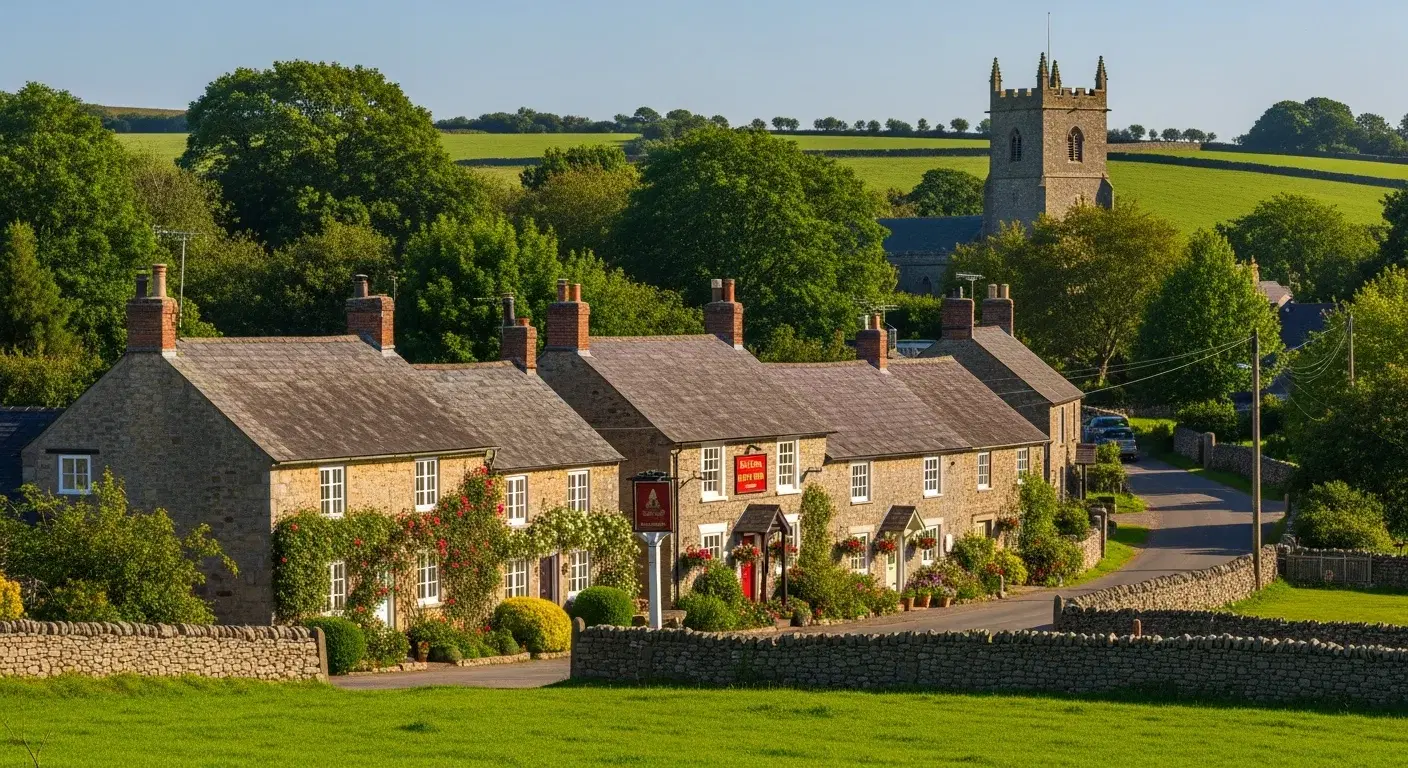
Stannington: A Guide to the Village South of Morpeth
A quiet Northumberland village with a country pub, a medieval church, good schools, and easy access to both Morpeth and the A1, here's what you need to know about Stannington.
If you're looking at the Morpeth area but want something quieter, a proper village rather than a market town, Stannington is worth knowing about. Sitting just south of Morpeth along the old Great North Road, it's a small, attractive Northumberland village with a strong community, a well-regarded pub, a medieval church, and easy access to both Morpeth town centre and the A1.
Here's what makes it tick.
Where Is Stannington?
Stannington lies roughly 3 miles south of Morpeth and 10 miles north of Newcastle, just off the A1. It's signposted from the dual carriageway, making it remarkably easy to reach despite its rural feel. The parish covers a large area, over 10,000 acres, but the village itself is compact, centred on Church Road and the old coaching route.
The population was around 1,280 at the last census. Small enough to know your neighbours; large enough to sustain a school, a pub, and a village hall.
Best for: 3 miles south of Morpeth, signposted from the A1. Population ~1,280. A proper village with a pub, church, school, and village hall.
The Ridley Arms
The Ridley Arms is the heart of village social life, a handsome 18th-century coaching inn in the heart of Lord Ridley's Northumberland estate. Originally called the Howard Arms (after the Earls of Carlisle who built it), it was later renamed for the Ridley family who own the surrounding land.
Now run by Sir John Fitzgerald, it's well-regarded for its food, classic British dishes with an emphasis on fresh local produce, and has several distinct areas including a sun-trap outdoor terrace. It's the kind of village pub people drive to, not just the local default. Read our full guide to The Ridley Arms for menu details, opening hours, and history.
Best for: 18th-century coaching inn with excellent food and a sunny terrace. A destination pub, not just a local.
St Mary the Virgin
Stannington's oldest building is the Church of St Mary the Virgin, which has stood on its current site since 1190. The present building dates from a reconstruction in 1871, but it incorporates the 13th-century north arcade of the medieval church, along with some medieval stained glass and grave covers.
It's a beautiful building in a quiet churchyard, the kind of place you'd walk past on a Sunday morning and hear bells. The church is active and holds regular services.
Stannington First School
Stannington First School is a community first school on Church Road, taking children from ages 3 to 9 (nursery through Year 4). Like the rest of the Morpeth area, Stannington uses the three-tier system, children move from here to one of the Morpeth middle schools (Chantry or Newminster), then on to King Edward VI School for their secondary education.
The school is small, a genuine village school where teachers know every child. For families, the combination of a village first school followed by an Outstanding-rated high school is a compelling draw.
Hepscott Park
One of the more unusual features of the Stannington area is Hepscott Park, a residential development built on the site of the former St Mary's Hospital, which was originally the Gateshead Lunatic Asylum. Some of the original 1930s hospital buildings survive, now converted into private homes, alongside newer houses. The Thomas Taylor retirement homes and the former Mona Taylor Maternity Hospital are also part of the site.
It's a distinctive place to live, period architecture in a parkland setting, with a character that new-builds can't replicate.
Property Market
Stannington commands a premium over Morpeth town centre, reflecting its village appeal and larger plots. The average sold price is around £379,000, with significant variation:
- 4-bed detached (the most common type): ~£454,000
- Station Road area: ~£510,000 average
- The Glebe: ~£415,000 average
Properties range from cottages in the village core to larger family homes in developments like St Mary Park, Netherton Park, and Hepscott Park. It's a market that skews towards families and professionals, people who want countryside on the doorstep but don't want to be remote.
Village Life
Beyond the pub, church, and school, Stannington has:
- Stannington Village Hall, opened in 1959, seats 150, hosts community events, has a bar and stage
- Two Grade II listed bus shelters, designed by Laurence Whistler in 1937, gifted by Lord Ridley to mark King George VI's coronation. You'd walk past them without noticing, but they're genuinely special.
- Access to open countryside in every direction, farmland, woodland, and the River Blyth valley
The village doesn't have a shop or a post office. You'll drive to Morpeth for those. But for many residents, that's part of the appeal. It's a place to live, not a place to consume.
Getting Around
- By car: the A1 is a couple of minutes away, giving fast access to Morpeth (5 min), Newcastle (20 min), and Alnwick (25 min northbound)
- By train: Morpeth station is 3 miles north, with services to Newcastle in under 20 minutes
- By bus: limited bus services connect Stannington to Morpeth and Newcastle, but a car is realistically necessary for daily life
Historical Footnote
Stannington has two notable, and sobering, historical institutions. The Stannington Children's Hospital was the first children's tuberculosis hospital in the country. And St Mary's Hospital (now Hepscott Park) operated as a psychiatric institution for over a century. Both are closed, but their legacy is visible in the architecture and the unusually large institutional buildings dotted around the parish.
Is Stannington Right for You?
Stannington suits families and professionals who want:
- A genuine village community, not a housing estate
- A good first school with access to Morpeth's Outstanding high school
- Countryside on the doorstep with easy A1/Morpeth access
- A quality pub within walking distance
It's less suited to anyone who needs shops, nightlife, or frequent public transport. This is a quiet village that's proud of being quiet.
Thinking about Stannington? Get in touch. We're happy to help with questions about the village and the wider Morpeth area.
Never miss what’s on
Join the weekly Morpeth.net digest — the best events, news and local tips, straight to your inbox. Free, one email a week.
What's On
Morpeth Wednesday Market
9:00am - 3:30pm · Market Place, Morpeth, NE61 1HG
October Quiz Night at Morpeth RFC
8:30 PM · Morpeth RFC, Grange House Fields, Mitford Road, Morpeth, NE61 1RJ
Halloween Spooktacular at Whitehouse Farm
See booking · Whitehouse Farm Centre, Stannington, Morpeth, Northumberland, NE61 6AW