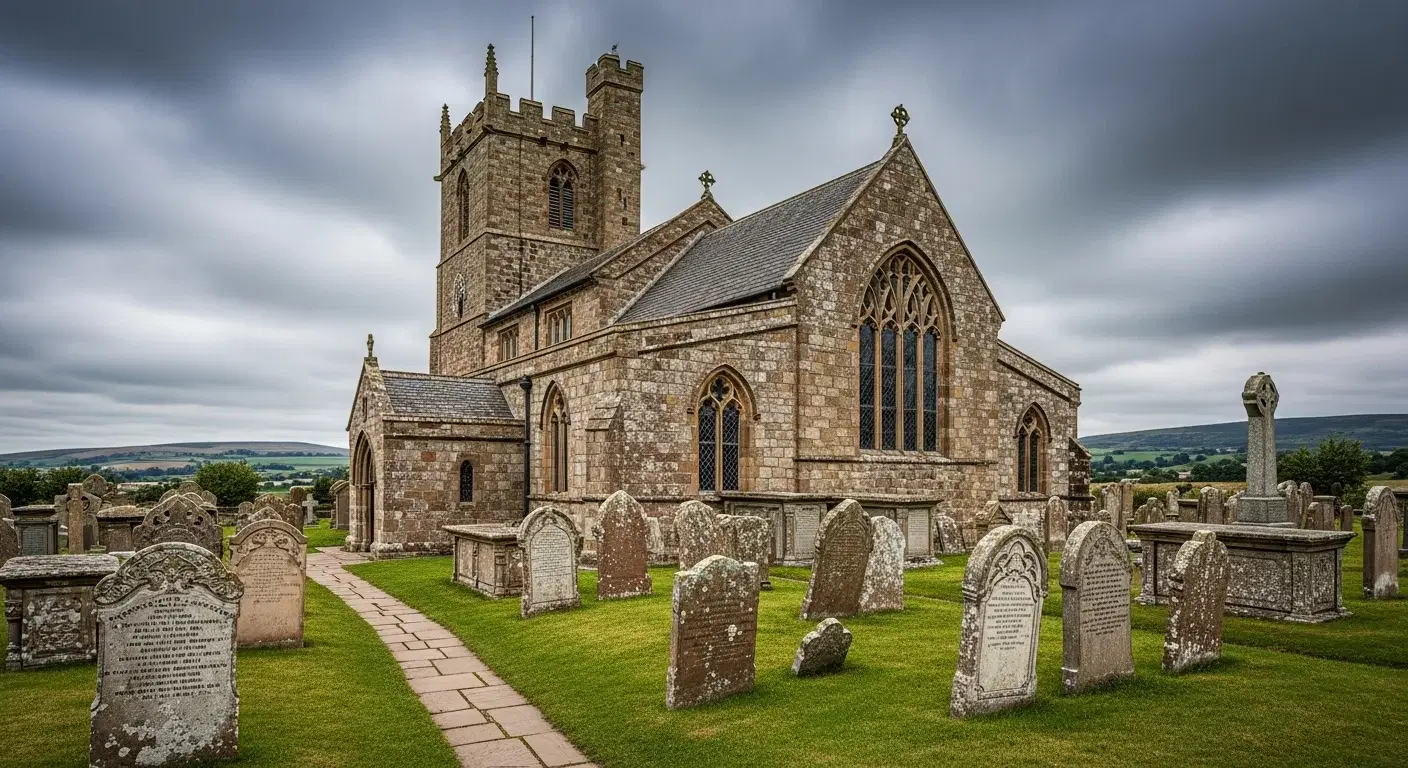
Churches in Morpeth
From the medieval parish church where suffragette Emily Davison is buried to a Victorian gem inspired by a Sicilian cathedral and a Gothic Revival Catholic church on Oldgate, here are the churches and places of worship in Morpeth.
Christianity has had a presence in Morpeth since Anglo-Saxon times, and the town's churches reflect centuries of faith, architecture, and community life. From a Grade I listed medieval parish church on a hilltop to a Victorian masterpiece in the town centre and a quietly influential Methodist chapel, Morpeth's places of worship are worth knowing about whether you attend services or simply appreciate fine buildings.
Here is our guide to the churches and places of worship in Morpeth.
St Mary the Virgin
St Mary the Virgin is the oldest and most historically significant church in Morpeth. Standing on Kirkhill, south of the River Wansbeck in the area known as High Church, the present building dates largely from the 14th century, though the site has been used for worship for far longer.
The church is Grade I listed and contains some outstanding features, including a celebrated 14th-century Tree of Jesse window, one of the finest pieces of medieval stained glass in the North East. The tower, nave, and chancel all repay careful attention, and the peaceful churchyard offers long views across the Wansbeck valley.
St Mary's is perhaps best known nationally as the final resting place of Emily Wilding Davison, the suffragette who was fatally injured when she stepped onto the track during the 1913 Epsom Derby. Her gravestone, inscribed with the Women's Social and Political Union motto "Deeds not words", is in the churchyard and remains a place of pilgrimage. The grave is separately Grade II listed by Historic England.
St Mary's is part of the Anglican Parish of Morpeth and holds regular Sunday services.
Best for: A Grade I listed medieval church with outstanding stained glass and the grave of Emily Wilding Davison.
St James the Great
St James the Great is the principal town-centre church of the Anglican Parish of Morpeth, standing just off Newgate Street with a fine entrance screen leading from the street into the churchyard.
The church was designed by architect Benjamin Ferrey and consecrated on 15 October 1846. It is built in a striking Romanesque style said to be modelled on the cathedral of Monreale in Sicily, an unusual source of inspiration for a Northumberland market town. The building is cruciform in plan, with nave and chancel aisles and a crossing tower, and is Grade II* listed.
Inside, the murals are a highlight. Painted around 1875 by the celebrated firm Clayton and Bell using the Gambier Parry process, they give the interior a rich, warm character quite different from the typical Victorian parish church. The church is open to visitors Monday to Thursday and Saturday from 10am to 4pm, Fridays from 11am to 4pm, and Sundays from noon to 6pm.
Best for: A striking Romanesque church in the town centre with notable Victorian murals by Clayton and Bell.
St Robert of Newminster Catholic Church
St Robert of Newminster is Morpeth's Roman Catholic parish church, situated on Oldgate close to the Clock Tower and adjacent to the River Wansbeck. The foundation stone was laid on 20 August 1848, and the church opened on 13 September 1849 before being consecrated by William Hogarth, the Apostolic Vicar of the Northern District, on 1 August 1850.
The building is in the Early English Gothic style and is Grade II listed. Its stained glass is by William Wailes, one of the most prolific Victorian glassmakers, whose Newcastle workshop produced windows for churches across the country. Around 1920, altar rails designed by Sir Giles Gilbert Scott, the architect of Liverpool Anglican Cathedral and the red telephone box. Were added to the interior.
St Robert's is named after Robert of Newminster, the 12th-century Cistercian monk who founded Newminster Abbey just outside the town in 1137. The church is part of the St Benet Biscop Partnership and the Diocese of Hexham and Newcastle. Sunday Masses are held at 9am and 11am.
Best for: A handsome Gothic Revival church with stained glass by William Wailes and altar rails by Giles Gilbert Scott.
St George's United Reformed Church
St George's United Reformed Church is one of the most prominent buildings on the Morpeth skyline, standing beside Telford Bridge at the foot of Bridge Street overlooking the River Wansbeck. The church dates from 1860 and has been an integral part of town life ever since.
The United Reformed Church was formed nationally in 1972 when the Congregational Church, the Presbyterian Church, and the Churches of Christ came together. St George's in Morpeth was one of the congregations that joined the new denomination.
Beyond Sunday worship, the building is an active community hub throughout the week, hosting the Morpeth Community Players theatre group, fitness classes, a meditation group, yoga sessions, and other activities. The congregation numbers around 80 on a typical Sunday.
Best for: A riverside landmark beside Telford Bridge, doubling as a busy community venue throughout the week.
Morpeth Methodist Church
Morpeth Methodist Church stands on Howard Terrace, a short walk from the town centre. Primitive Methodists first came to Morpeth in 1811, though the first chapel was not built until 1872 on Manchester Street. The present church dates from 1904 and serves around 150 families.
Like several of Morpeth's churches, the building plays a dual role as a place of worship and a community resource. The church hall is used throughout the week by numerous groups and is available for hire. It is also a regular venue for the Morpeth Music Society, which has been bringing classical music to the town since 1944.
Best for: A well-supported Methodist congregation with a church hall that hosts concerts and community groups.
A note on Morpeth's wider church history
Morpeth's ecclesiastical heritage extends well beyond the churches that stand today. The town was once home to Newminster Abbey, a Cistercian monastery founded in 1137 that became one of the great religious houses of northern England before its dissolution in 1537. The Chantry, the 13th-century bridge chapel that now houses the Bagpipe Museum, is another reminder of the central role the church played in medieval Morpeth.
Whether you are looking for a Sunday service, a midweek concert, or simply want to admire some fine architecture, Morpeth's churches are well worth a visit.
Know a church or place of worship we've missed? Get in touch.
Never miss what’s on
Join the weekly Morpeth.net digest — the best events, news and local tips, straight to your inbox. Free, one email a week.
What's On
Morpeth Wednesday Market
9:00am - 3:30pm · Market Place, Morpeth, NE61 1HG
October Quiz Night at Morpeth RFC
8:30 PM · Morpeth RFC, Grange House Fields, Mitford Road, Morpeth, NE61 1RJ
Halloween Spooktacular at Whitehouse Farm
See booking · Whitehouse Farm Centre, Stannington, Morpeth, Northumberland, NE61 6AW