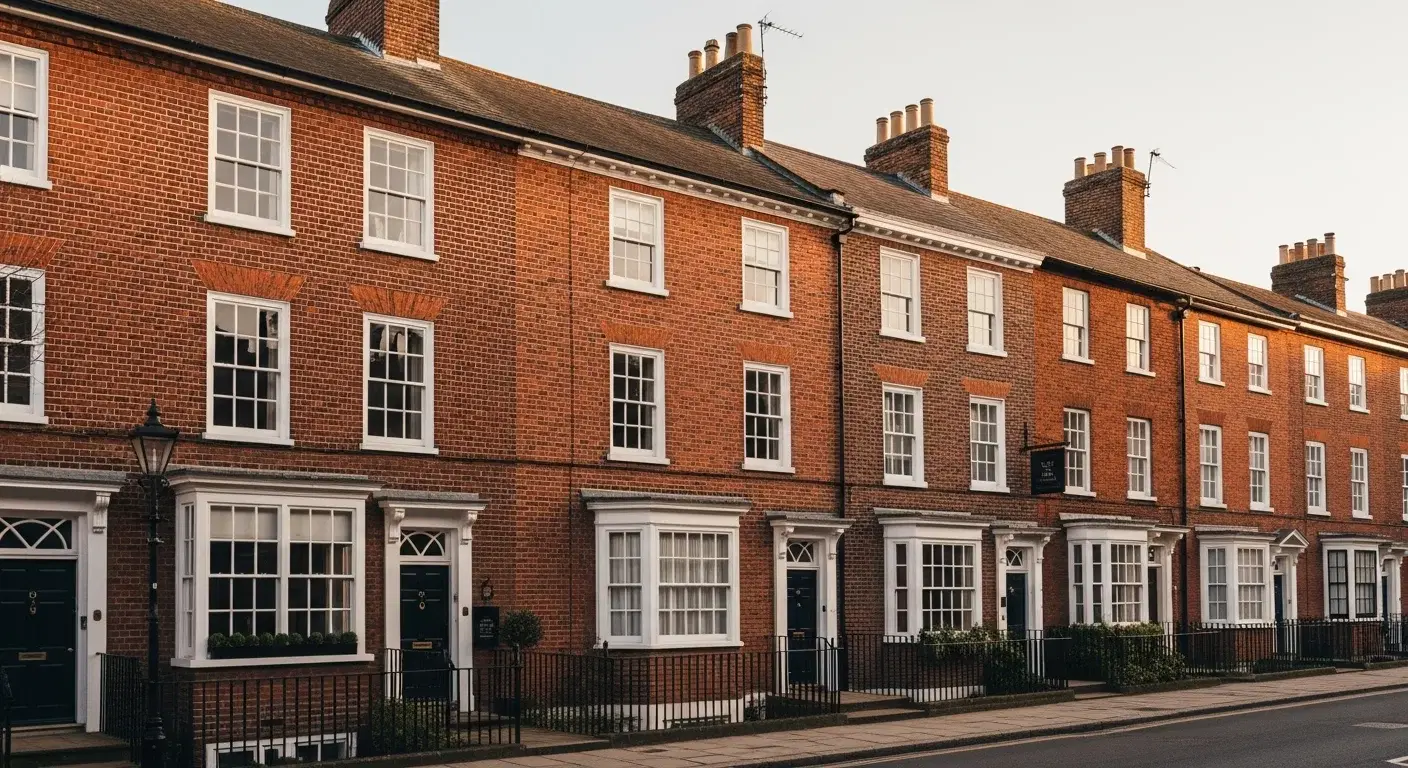
The Great Fire of Morpeth, 1689
In 1689 an accidental fire destroyed much of Morpeth, wiping out the medieval town centre. The rebuilding that followed gave the town its distinctive Georgian brick streetscape.
Walk through Morpeth town centre today and you will notice something unusual for a Northumberland market town. Where most settlements in the county are built from local sandstone, much of Morpeth's historic core is brick, elegant Georgian facades in warm red and orange, laid in English garden wall bond, with neat sash windows and classical proportions. The reason for this distinctive appearance is a single catastrophic event: the Great Fire of 1689.
What Happened
In 1689, an accidental fire broke out in the town and spread rapidly through Morpeth's tightly packed medieval streets. The buildings of the time were largely timber-framed with thatched or wooden roofs, the same construction that had made English towns vulnerable to fire for centuries.
The destruction was devastating. A large proportion of the town's buildings were destroyed, leaving the community to rebuild almost from scratch. Contemporary accounts describe the fire as causing "great devastation", though Morpeth "speedily recovered from the disaster".
The exact cause of the fire is not recorded in surviving sources. What is clear is that the scale of destruction was comparable to the great fires that struck other English towns in the 17th century, the Great Fire of London in 1666, the fire at Warwick in 1694, and the fire at Northampton in 1675. In each case, densely built medieval townscapes were swept away in hours.
Best for: The 1689 fire destroyed much of medieval Morpeth. The town was rebuilt in brick, giving it the Georgian character visible today.
What Survived
Not everything was lost. Several structures that predate the fire still stand in Morpeth today:
- The Clock Tower, built between 1604 and 1634 from recycled medieval stone, the Clock Tower on Oldgate survived the fire and remains one of Morpeth's most recognisable landmarks. Originally a bell tower for calling the town watch, it still stands at the junction of Oldgate and Bridge Street.
- Morpeth Castle, the 14th-century gatehouse on the hill above the town was already in partial ruin following the Civil War siege of 1644, but its stone construction meant it was unaffected by the fire below.
- The Chantry, the 13th-century bridge chapel on the old crossing of the Wansbeck, now home to the Bagpipe Museum, also survived.
- St Mary the Virgin, the parish church, which dates from the 14th century, escaped the worst of the fire.
These survivors give a sense of what the pre-fire town looked like: stone public buildings and churches amid a sea of timber domestic properties.
The Georgian Rebuilding
The fire created an opportunity as well as a disaster. With so much of the town destroyed, Morpeth's landowners and merchants rebuilt using the latest materials and architectural fashions. The result was a wave of brick construction that was almost unique in Northumberland at the time.
Where most Northumbrian towns continued to build in stone, Morpeth adopted brick, partly because it was cheaper and quicker for large-scale reconstruction, and partly because brick was fashionable in the late 17th and early 18th centuries. The new buildings featured sash windows, symmetrical facades, and the kind of classical proportions that we now associate with the Georgian era.
The construction technique of choice was English garden wall bond, a pattern of brickwork using alternating courses of headers and stretchers that gives the facades their distinctive rhythm. Walk along Bridge Street or Newgate Street today and you can still read this pattern in the brickwork of buildings that date from the decades after the fire.
The Town Plan
Interestingly, the fire did not lead to a wholesale replanning of the town. Unlike the Great Fire of London, which prompted ambitious (if largely unrealised) schemes to redesign the street layout, Morpeth was rebuilt on its existing medieval plan. The long, narrow burgage plots running back from the main streets, a pattern established when the town received its market charter in 1199, survived the fire and continued to shape development.
This means that Morpeth's Georgian facades sit on a fundamentally medieval street plan. The contrast between the orderly 18th-century frontages and the irregular medieval plots behind them is one of the town's quiet architectural pleasures.
Best for: Morpeth's Georgian brick facades sit on a medieval street plan, burgage plots dating back to the 1199 market charter.
A Town Shaped by Fire
The Great Fire of 1689 is the single most important event in the physical history of Morpeth. Without it, the town centre would look quite different, probably more like Alnwick or Hexham, with their stone-built medieval and Tudor streetscapes. Instead, Morpeth has a character that is distinctively its own: a Georgian brick town in a county of stone.
The fire also shaped the town's development in less visible ways. The speed of the rebuilding, Morpeth recovered quickly by the standards of the time, suggests a prosperous and well-organised community. The adoption of brick over stone was a practical choice, but it also signalled confidence and modernity.
Seeing the Legacy Today
You can trace the fire's legacy on a short walk through the town centre:
- Bridge Street, the main commercial street, where many of the Georgian brick facades date from the rebuilding period
- Oldgate, home to the pre-fire Clock Tower and several 18th-century buildings
- Newgate Street, more Georgian brick frontages with characteristic sash windows
- The Market Place, the heart of the town since the medieval period, surrounded by post-fire buildings
For a deeper understanding of Morpeth's architectural heritage, the Morpeth Heritage group has published detailed studies of the town's 18th-century buildings, many of which can be traced directly to the post-fire rebuilding.
Get in touch if you have historical information or images relating to the Great Fire of 1689.
Never miss what’s on
Join the weekly Morpeth.net digest — the best events, news and local tips, straight to your inbox. Free, one email a week.
What's On
Morpeth Wednesday Market
9:00am - 3:30pm · Market Place, Morpeth, NE61 1HG
October Quiz Night at Morpeth RFC
8:30 PM · Morpeth RFC, Grange House Fields, Mitford Road, Morpeth, NE61 1RJ
Halloween Spooktacular at Whitehouse Farm
See booking · Whitehouse Farm Centre, Stannington, Morpeth, Northumberland, NE61 6AW