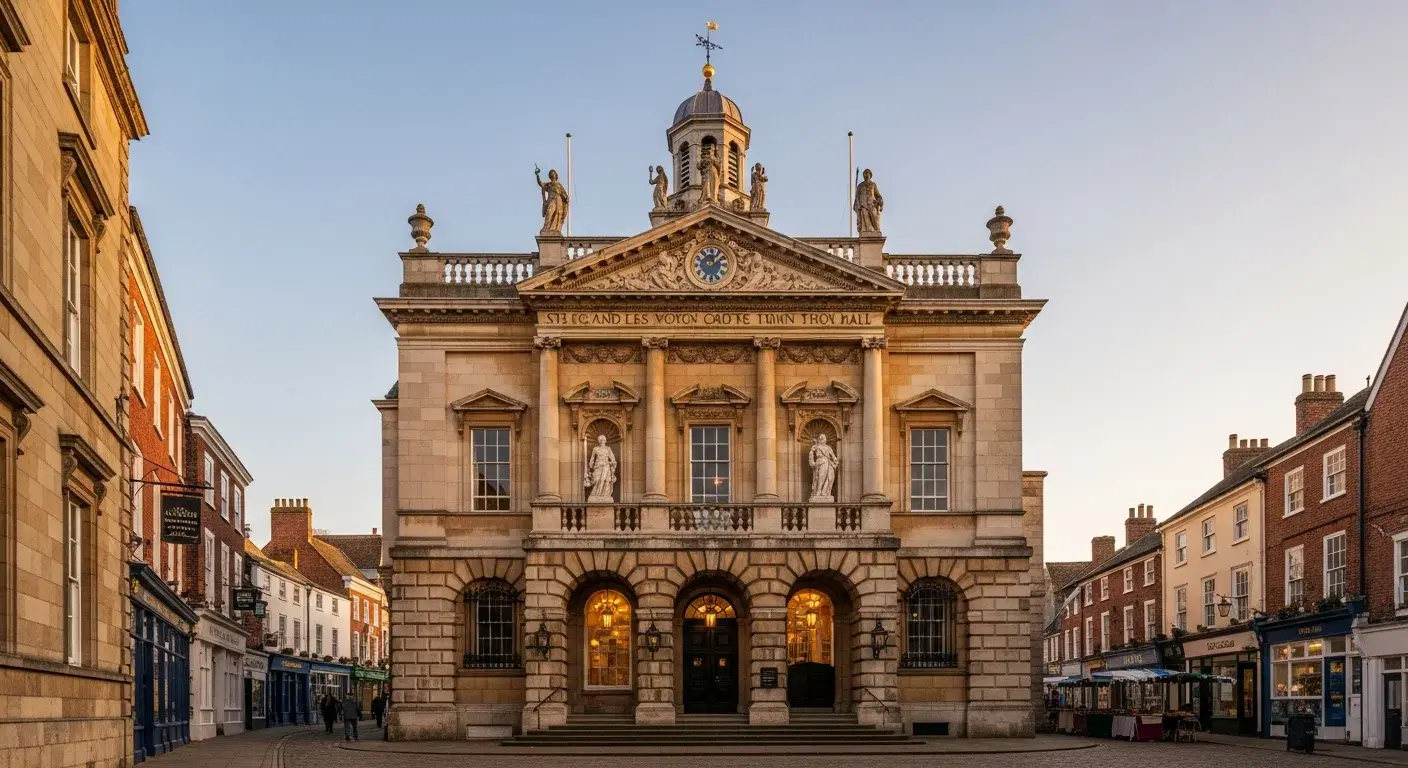
John Vanbrugh's Hidden Masterpiece: Morpeth Town Hall
Few people know that Morpeth's Town Hall was designed by Sir John Vanbrugh, the architect of Blenheim Palace and Castle Howard. Here is the story of this overlooked Baroque gem.
Walk through Morpeth's Market Place and you will pass a handsome stone building with rusticated arches, turrets, and a bold Baroque facade. It is the Town Hall, and it was designed by Sir John Vanbrugh, one of the most celebrated architects in British history. The same man who created Blenheim Palace for the Duke of Marlborough and Castle Howard for the Earl of Carlisle also designed a municipal building for a small market town in Northumberland. It is one of the least-known facts about Morpeth.
The Vanbrugh Connection
John Vanbrugh (1664-1726) was a playwright, soldier, and architect whose grand country houses defined the English Baroque. His two most famous works, Blenheim Palace in Oxfordshire and Castle Howard in North Yorkshire, are among the greatest buildings in the country.
The connection to Morpeth came through the Earl of Carlisle, who was both the patron of Castle Howard and the lord of Morpeth. When the town needed a new civic building in the early 18th century, it was the Earl who commissioned Vanbrugh to design it. The Town Hall was completed in 1714, the same year that Queen Anne died and the Georgian era began.
Best for: Morpeth Town Hall was designed by Sir John Vanbrugh, the architect behind Blenheim Palace and Castle Howard.
The Original Building
The Town Hall was built on the west side of the Market Place in rusticated ashlar stone, a hallmark of the Baroque style. Vanbrugh's design featured a piazza at ground level, an open arcade of arches that served as a butter market, where farmers and traders could sell their goods under cover. Above this sat the main hall and civic rooms.
The turrets and bold stonework are unmistakably Vanbrugh. Even on a modest civic building, his style is theatrical and confident, qualities that set him apart from the more restrained Palladian architects who followed him. The Town Hall may be small by Vanbrugh's standards, but it carries his signature clearly.
The building served as the centre of civic life in Morpeth for over a century and a half. Markets, meetings, and local government business all took place here.
Fire and Faithful Reconstruction
On the night of 24 September 1869, a serious fire broke out in the Town Hall, causing extensive damage to the interior and upper storeys. The facade survived, but much of the structure behind it was destroyed.
The 8th Earl of Carlisle funded the rebuilding at his own expense, appointing the local architect Robert James Johnson to oversee the work. Johnson's brief was clear: the facade must be an exact reproduction of Vanbrugh's original design. The interior was completely rebuilt, but the exterior was restored so faithfully that the building's appearance today closely matches what Vanbrugh intended in 1714.
This faithful reconstruction means that while the stonework you see is largely Victorian, the design remains Vanbrugh's. Few buildings in England can claim to preserve a Vanbrugh design through such careful restoration.
The 2009 Restoration
By the early 2000s, the Town Hall was again in need of attention. The Greater Morpeth Development Trust commissioned a major programme of restoration works, carried out by Napper Architects and completed in 2009 at a cost of £1.1 million.
The restoration improved access to the butter market at ground level, restored the grand staircase, and brought the building up to modern standards while respecting its historic character. The Town Hall continues to serve as a venue for civic events, exhibitions, and community gatherings.
Best for: The Town Hall was restored in 2009 at a cost of £1.1 million, preserving Vanbrugh's Baroque design for future generations.
Why It Matters
Vanbrugh buildings are rare. Outside the great country houses and a handful of other commissions, very few survive. The fact that Morpeth has one, and that it sits in the middle of town, freely visible to anyone walking through the Market Place, is something the town can rightly be proud of.
Most visitors to Blenheim Palace or Castle Howard have no idea that the same architect also worked in Morpeth. It is a connection worth celebrating, and it places this small Northumberland market town in distinguished architectural company.
For more of Morpeth's remarkable heritage, see our guides to Morpeth Castle, the Chantry, and Emily Wilding Davison.
Visiting
| Detail | Info |
|---|---|
| Location | Market Place, Morpeth, NE61 1LZ |
| Access | The exterior and butter market arcade are freely visible; internal access depends on events |
| Listed status | Grade II* |
| Nearest parking | Town centre car parks within a few minutes' walk |
The Town Hall is at the heart of Morpeth's Market Place, next to the Wednesday market and within easy reach of Bridge Street and the Sanderson Arcade. Look up as you pass, there is a Vanbrugh masterpiece hiding in plain sight.
Get in touch if you have historical information or photographs of Morpeth Town Hall to share.
Never miss what’s on
Join the weekly Morpeth.net digest — the best events, news and local tips, straight to your inbox. Free, one email a week.
What's On
Morpeth Wednesday Market
9:00am - 3:30pm · Market Place, Morpeth, NE61 1HG
October Quiz Night at Morpeth RFC
8:30 PM · Morpeth RFC, Grange House Fields, Mitford Road, Morpeth, NE61 1RJ
Halloween Spooktacular at Whitehouse Farm
See booking · Whitehouse Farm Centre, Stannington, Morpeth, Northumberland, NE61 6AW