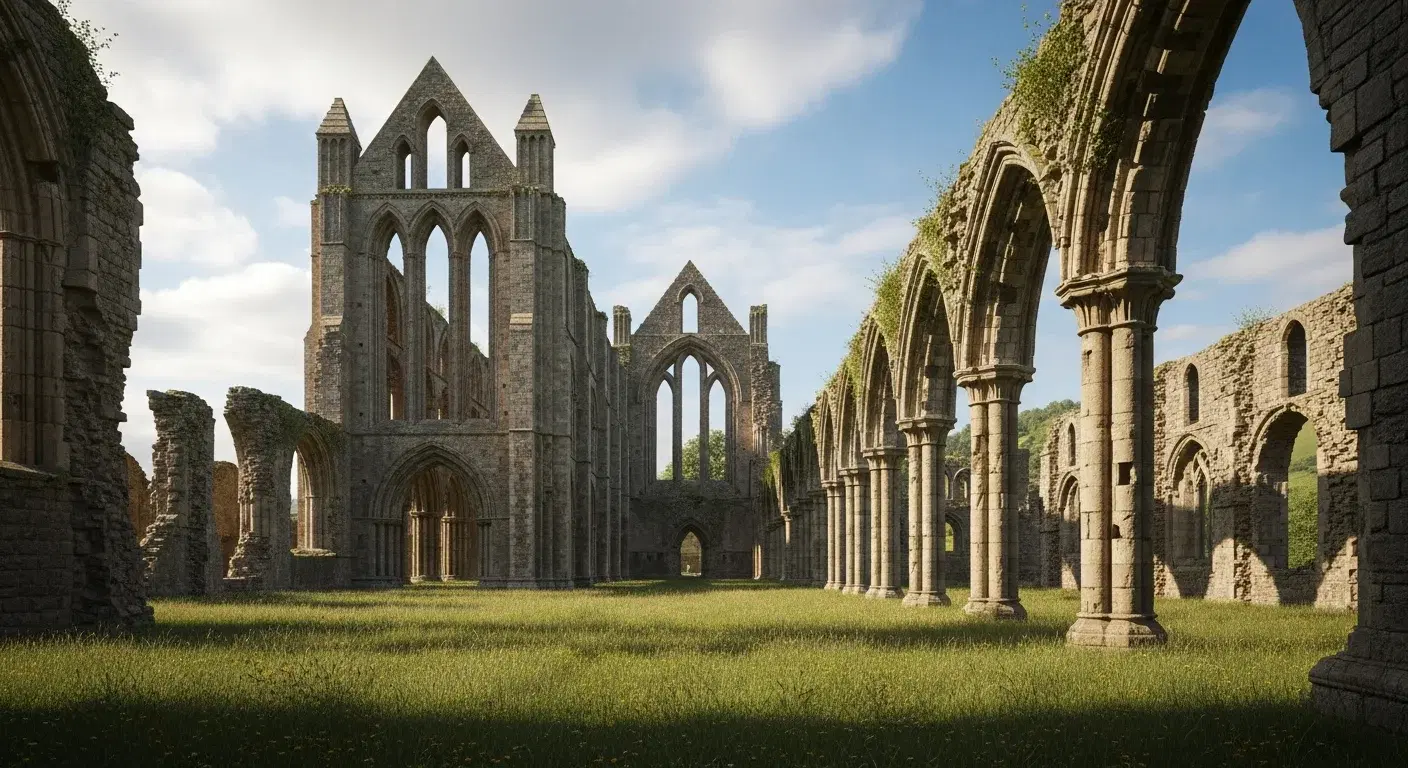
Newminster Abbey: Northumberland's Forgotten Cistercian Ruin
Founded in 1137 by the lord of Morpeth, Newminster Abbey became one of the great Cistercian houses of northern England before its dissolution in 1537. Today its ruins sit hidden and almost forgotten.
Two miles west of Morpeth, hidden behind trees on private land near the River Wansbeck, lie the remains of one of the most important medieval monasteries in northern England. Newminster Abbey was once a powerhouse of the Cistercian order, a place of pilgrimage, scholarship, and vast landholding. Today it is overgrown, Grade II listed, and on Historic England's Heritage at Risk register. Most people in Morpeth have never seen it.
Here is its story.
Foundation by Ranulf de Merlay
In 1137, Ranulf de Merlay, lord of the Barony of Morpeth, and his wife Juliana, daughter of Gospatric II, Earl of Lothian, founded a new monastery on the banks of the Wansbeck. The site was close to the village of Mitford, in a river valley typical of Cistercian foundations: remote, fertile, and well-watered.
The monks came from Fountains Abbey in Yorkshire, making Newminster one of its earliest daughter houses. This connection to Fountains placed the new abbey within the most dynamic branch of the Cistercian movement in England, a network of white-robed monks whose influence stretched across the country.
Best for: Newminster was a daughter house of Fountains Abbey, one of the great Cistercian foundations of medieval England.
Saint Robert of Newminster
The abbey's first abbot was Robert of Newminster, who governed the community from 1138 until his death in 1159. Under Robert's leadership, the abbey grew rapidly. Despite a devastating attack by Scottish raiders in 1138, just a year after the foundation, which burned the original timber buildings to the ground, the community rebuilt and thrived.
So successful was Newminster that it founded three daughter houses of its own: Pipewell Abbey in Northamptonshire (1143), Roche Abbey in South Yorkshire (1147), and Sawley Abbey in Lancashire (1147). For a monastery barely a decade old, this was remarkable expansion.
Robert was buried beneath the high altar after his death. His tomb became a site of pilgrimage, and miracles were attributed to him. He was eventually canonised as Saint Robert of Newminster, and his feast day, 7 June, was observed across the Cistercian world.
Growth and Prosperity
At its height, Newminster Abbey was one of the largest Cistercian establishments in northern England. The monks farmed extensive granges across Northumberland, managed sheep flocks on the uplands, and held rights to fisheries, mills, and markets. A survey of the abbey's possessions made on 1 July 1536, just months before its closure, recorded a substantial estate.
The abbey buildings themselves would have followed the standard Cistercian plan: a cruciform church, a cloister, a chapter house, a dormitory, a refectory, and a range of working buildings for brewing, baking, and storage. Stone from local quarries gave the complex a permanence that belied its eventual fate.
The community also had a troubled relationship with its neighbours. Disputes over land and grazing rights with the lords of Mitford and other local families were not uncommon, and the abbey's records contain references to conflicts that sometimes turned violent.
Dissolution in 1537
Newminster was dissolved during the first wave of Henry VIII's suppression of the monasteries in 1537. The community surrendered, and the Crown took possession of the estate.
What followed was systematic demolition. The estate was leased to the Grey family, who used the abbey buildings as a quarry, stripping stone for their own construction projects. Lead was stripped from the roofs, timber was carted away, and within a generation the great abbey was reduced to fragmentary walls and foundations.
This was a common fate for dissolved monasteries, but at Newminster the destruction was particularly thorough. Unlike Morpeth Castle, which retained its gatehouse, or the Chantry on the bridge, which found new uses, Newminster had no obvious second life. It simply decayed.
What Remains Today
The ruins are in a fragmentary but stabilised condition. Low walls, foundations, and earthworks mark the outline of the abbey church and claustral buildings. The site is a Scheduled Ancient Monument and has been a Grade II listed building since 1950.
However, Newminster is on Historic England's Heritage at Risk register. The site is on private land with no formal public access, and vegetation has encroached heavily. From the nearby footpath along the Wansbeck, you can glimpse the ruins through the trees, but there are no interpretation boards and no visitor facilities.
This is part of what makes Newminster both poignant and frustrating. A monastery that once rivalled any in the North East is now essentially invisible, known to local historians and walkers, but hidden from the casual visitor.
Best for: The abbey ruins are on private land with no public access. You can glimpse them from the riverside footpath between Morpeth and Mitford.
Walking to Newminster
The best way to appreciate the abbey's setting is on foot. The popular riverside walk from Morpeth towards Mitford passes close to the site. From the town centre, follow the Wansbeck westward along the north bank, a route that also features in our guide to the best walks from Morpeth.
The walk is roughly 2 miles each way on level ground, suitable for most abilities. You will pass through pleasant river meadows and woodland, with the abbey ruins visible across the fields to your right as you approach Mitford.
A Forgotten Giant
Newminster Abbey deserves to be better known. Founded in the same year as many of England's most famous abbeys, home to a canonised saint, and mother to three daughter houses, it was a place of genuine significance. Its position on the Heritage at Risk register is a reminder of how much of Northumberland's medieval heritage remains vulnerable.
For anyone interested in Morpeth's heritage, a walk along the Wansbeck to see what little remains of Newminster is a sobering and rewarding experience.
Get in touch if you have historical information or photographs of Newminster Abbey to share.
Never miss what’s on
Join the weekly Morpeth.net digest — the best events, news and local tips, straight to your inbox. Free, one email a week.
What's On
Morpeth Wednesday Market
9:00am - 3:30pm · Market Place, Morpeth, NE61 1HG
October Quiz Night at Morpeth RFC
8:30 PM · Morpeth RFC, Grange House Fields, Mitford Road, Morpeth, NE61 1RJ
Halloween Spooktacular at Whitehouse Farm
See booking · Whitehouse Farm Centre, Stannington, Morpeth, Northumberland, NE61 6AW