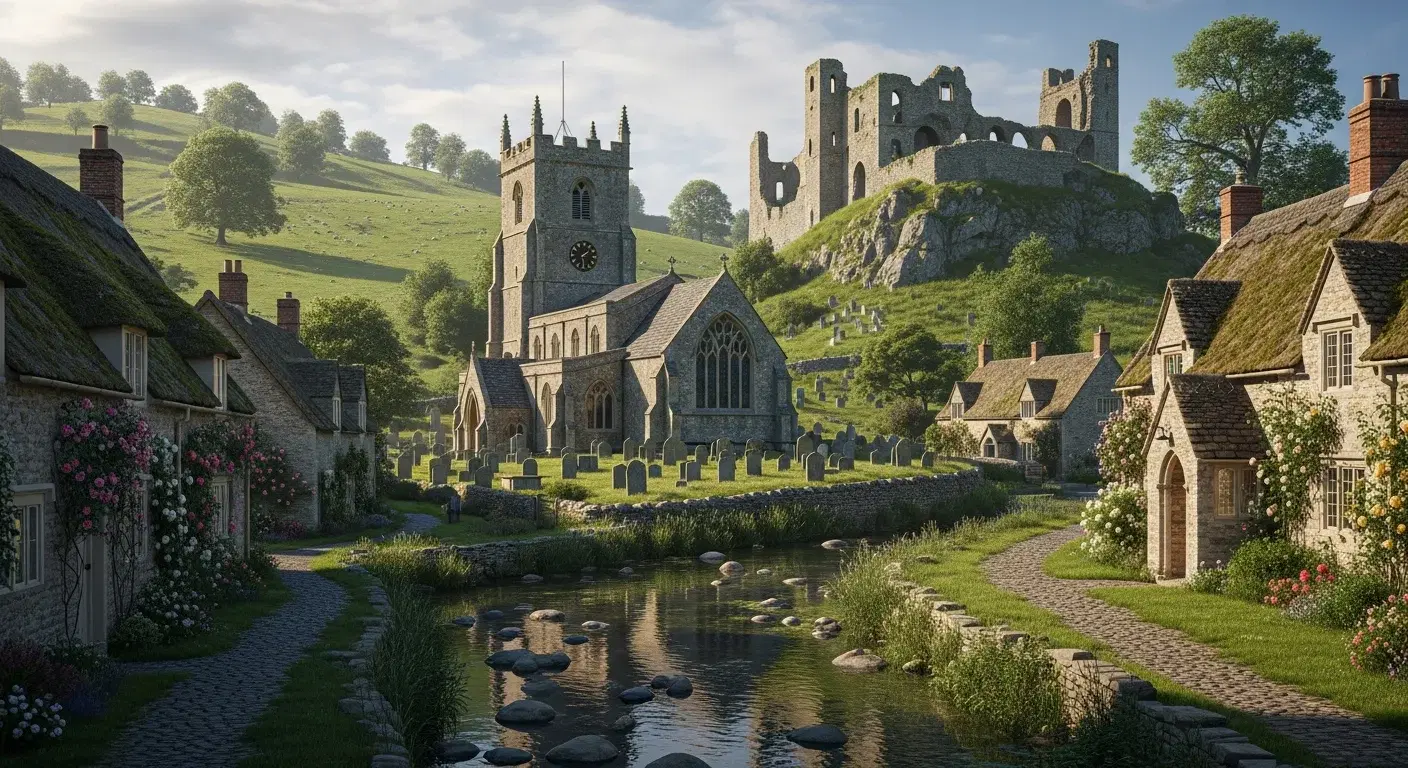
Mitford Village: Morpeth's Beautiful Neighbour
A quiet village two miles west of Morpeth with Norman castle ruins, one of Northumberland's oldest churches, a Georgian mansion by John Dobson, and peaceful riverside walks.
Two miles west of Morpeth, where the River Wansbeck curves through a wooded valley, sits Mitford, a tiny Northumberland village with a history that stretches back far beyond the town it now neighbours. There is a Norman castle, one of the oldest churches in the Diocese of Newcastle, a Georgian mansion by one of the North East's greatest architects, and some of the loveliest riverside walking in the county.
And yet Mitford gets almost no visitors. No crowds, no car parks, no gift shops. Just a quiet village doing what it has done for nine hundred years.
A Brief History
Mitford's story is older than Morpeth's. Around 1110, the village was granted a market charter, one of the first north of the River Tyne. For a time, Mitford was a more significant trading centre than Morpeth, which did not receive its own charter until 1199.
The village was the seat of the Mitford family, who held the barony and gave the settlement its name. Their castle and church, both dating from the 12th century, made Mitford a place of real importance in medieval Northumberland. But the violence of the 13th century, including the sacking of the castle by King John in 1216, shifted power eastward to Morpeth. Mitford shrank, and it has remained small ever since.
Best for: Mitford had a market charter from around 1110, nearly a century before Morpeth received its own in 1199.
Mitford Castle
The ruins of Mitford Castle stand on a wooded bluff above the Wansbeck. Built between 1150 and 1170 by William Bertram, it was one of the largest fortifications in Northumberland at the time, a five-sided keep with thick walls and a commanding position over the river crossing.
The castle had a turbulent history. In 1216, King John besieged and sacked it during his campaign through the North. The following year, it was besieged again by the Scots. By 1323, the castle was no longer in use, and it has been a ruin ever since.
What remains is fragmentary but atmospheric, broken walls rising from the trees, with views down to the river. The ruins are on private land, but they can be seen from the public footpath that runs along the Wansbeck. For anyone interested in Morpeth's castle, Mitford offers a fascinating comparison: a Norman fortress that was abandoned rather than repurposed.
St Mary Magdalene Church
The Church of St Mary Magdalene is the jewel of Mitford. A church has stood on this site since at least 1135, and recently discovered foundations suggest there may have been a Saxon church here before that.
The building has endured extraordinary violence. In 1216, when King John sacked the castle, his forces also burned the church, with many of the villagers who had taken sanctuary inside still within its walls. The church was rebuilt in the 13th century by William de Valence, incorporating pillars, a corbel, the chancel door, and foundations from the original 12th-century building.
Further damage came in a fire in 1705, and the church was substantially rebuilt again in 1875. Despite this, it preserves its Norman south arcade and 13th-century chancel, tangible links to the medieval building.
The church's most remarkable possession is its bell, cast no later than about 1150. It is believed to be the oldest bell in the Diocese of Newcastle, and possibly one of the oldest in the country. The church also contains a leper squint, a small opening in the wall through which lepers could observe the service without entering the building.
Best for: St Mary Magdalene has a bell dating to around 1150, thought to be the oldest in the Diocese of Newcastle.
Mitford Hall
On the south bank of the Wansbeck, overlooking the river and the village, stands Mitford Hall, a Georgian mansion built in 1828 by the Mitford family to a design by John Dobson.
Dobson was the most prominent architect in northern England during the 19th century, responsible for over 50 churches and 100 private houses, as well as Newcastle's Central Station. At Mitford, he created an elegant country house in his characteristic style, with ashlar facades, graduated slate roofs, and classical detailing that adapts southern Georgian conventions for Northumberland's harsher climate.
The hall sits in its own 85-acre park and is a Grade II listed building*. It replaced an older manor house on the opposite side of the river. The hall is not open to the public, but its grounds and the surrounding parkland contribute to the beauty of the Wansbeck valley.
Walking to Mitford
The best way to visit Mitford is on foot from Morpeth. The riverside path along the Wansbeck is one of the finest walks from Morpeth, level, scenic, and roughly 2 miles each way.
From the town centre, head west along the north bank of the river. The path passes through meadows and woodland, with views of the castle ruins and the remains of Newminster Abbey along the way. You can cross the river at Mitford and return along the south bank for a circular route of about 4 miles.
The walk is suitable for most abilities and is popular with dog walkers. There is no dedicated car parking in Mitford village, so walking from Morpeth is genuinely the best option.
Best for: Walk from Morpeth along the Wansbeck, 2 miles each way on level ground, with castle ruins and river views throughout.
The Village Today
Mitford today is a peaceful, largely residential village with no pub, no shop, and no tourist infrastructure. The parish council maintains the village green and the small war memorial. The church holds regular services.
What Mitford does have is beauty, history, and quiet. It is the kind of place where you hear birdsong and running water, where the medieval past is still visible in the landscape, and where you can walk for an hour without seeing another person.
For anyone living in or visiting Morpeth, Mitford is an easy and rewarding excursion. Combined with a visit to the Newminster Abbey ruins, it makes for a half-day of walking and history that rivals anything in the county.
See also our guide to Stannington, another village near Morpeth with its own character and history.
Get in touch if you have information or photographs of Mitford village to share.
Never miss what’s on
Join the weekly Morpeth.net digest — the best events, news and local tips, straight to your inbox. Free, one email a week.
What's On
Morpeth Wednesday Market
9:00am - 3:30pm · Market Place, Morpeth, NE61 1HG
October Quiz Night at Morpeth RFC
8:30 PM · Morpeth RFC, Grange House Fields, Mitford Road, Morpeth, NE61 1RJ
Halloween Spooktacular at Whitehouse Farm
See booking · Whitehouse Farm Centre, Stannington, Morpeth, Northumberland, NE61 6AW