Interesting Facts About Morpeth
From a name that means murder path to a suffragette's grave, a bagpipe museum in a medieval chapel and a curfew bell that still rings at eight, here are the stories that make Morpeth so distinctive.
Morpeth wears its history well. This handsome market town on the River Wansbeck has been a Norman stronghold, a droving centre for Scottish cattle, and the burial place of one of the most famous figures in the fight for women's votes. For a county town of around 14,000 people it holds a remarkable number of oddities, firsts and proud moments. Here is a roundup of the facts that make Morpeth worth boasting about.
The name may mean murder path
Morpeth's name is thought to derive from the Old English morth path, which translates uncomfortably as murder path. The most common explanation is that it referred to the robberies and killings that befell travellers on the medieval road north towards Scotland, which ran through the town. Whether the reputation was ever deserved, the name has stuck for the best part of a thousand years and gives Morpeth one of the more sinister-sounding place names in the North East.
Best for: a startling opener: a genteel market town whose name once meant murder path.
A Norman castle and a gatehouse you can stay in
A motte-and-bailey castle was raised here by William de Merlay around 1095, and a later stone castle followed in the 13th century. Much of it is gone, but the inner gatehouse survives and has been carefully restored by the Landmark Trust, which now lets it out as self-catering holiday accommodation. You can quite literally book a night in Morpeth Castle's gatehouse, high on its wooded hill above the town.
The market charter dates back to 1200
King John granted Morpeth a market charter in 1200, and by the mid 1700s the town had grown into one of the most important markets in England, especially for the Scottish cattle driven south by drovers. That trading heritage still shapes the town centre today, with a weekly market on Bridge Street and a monthly farmers' market keeping the tradition alive.
Emily Wilding Davison is buried here
Morpeth is the resting place of the suffragette Emily Wilding Davison, who died in 1913 after stepping in front of the King's horse at the Epsom Derby. Her body was brought north by train and buried in the churchyard of St Mary the Virgin. Her headstone carries the movement's famous motto, deeds not words, and the grave remains a place of pilgrimage. A statue in her memory now stands in the town's Carlisle Park.
Best for: a moment of national history: the grave of the suffragette whose death shocked the country.
A bagpipe museum in a medieval chapel
The Morpeth Chantry Bagpipe Museum occupies the Chantry, a 13th-century bridge chapel and one of only a handful of such buildings to survive in England. Over the centuries it has served as a chapel, a grammar school, a mineral-water works and more, and it was here that the naturalist William Turner, often called the father of English botany, began his education. Today it holds a collection of more than 120 sets of pipes, with a special focus on the Northumbrian smallpipes.
A curfew bell that still rings at eight
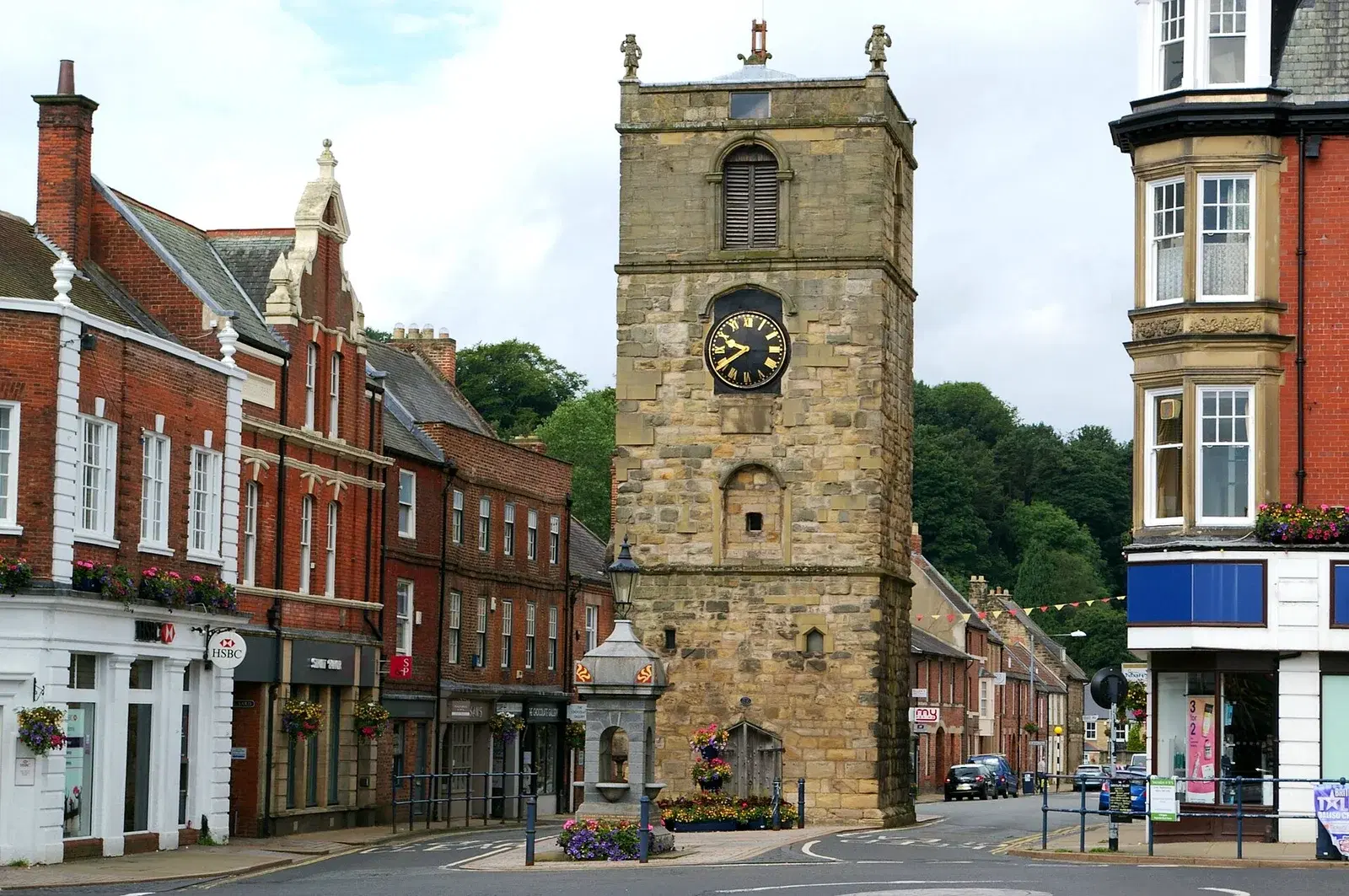
Morpeth's free-standing Clock Tower on Oldgate was built between around 1604 and 1634, partly from stone recycled from the ruined Newminster Abbey. Its six bells arrived in 1706, and to this day the curfew bell rings out at eight o'clock every evening, a survival of a medieval custom that has all but vanished elsewhere. The Clock Tower is one of very few detached bell towers of its kind in the country.
A town hall by Vanbrugh and a park by a countess
Morpeth's Town Hall was originally designed by Sir John Vanbrugh, the architect of Blenheim Palace and Castle Howard, though the building was rebuilt in 1869 after a fire. Just across the river, Carlisle Park sits on land given to the town by the Countess of Carlisle in 1916. Opened in 1929, it contains the William Turner Garden and one of only a handful of floral clocks left in England, along with an aviary, ancient woodland and riverside walks.
Admiral Collingwood's happiest place
Vice Admiral Cuthbert Collingwood, Nelson's second-in-command at Trafalgar, kept a home in Oldgate and was devoted to the town. He is remembered for saying that whenever he thought about how to be happy again, his thoughts carried him back to Morpeth. Praise like that, from a man who spent much of his life at sea in command of the fleet, tells you a good deal about how the town was regarded.
Frequently asked questions
What does the name Morpeth mean? Morpeth is thought to come from the Old English morth path, meaning murder path, a reference to robberies and killings on the medieval road north to Scotland that ran through the town. The name has been in use for close to a thousand years.
Why is Emily Wilding Davison buried in Morpeth? Emily Wilding Davison's family had strong Northumberland roots, and after her death at the 1913 Derby her body was brought to Morpeth for burial in St Mary the Virgin churchyard. Her grave carries the suffragette motto deeds not words, and a statue stands in Carlisle Park.
Can you visit the Morpeth Chantry Bagpipe Museum? Yes. The museum sits in the medieval Chantry on Bridge Street, alongside the tourist information centre, and holds more than 120 sets of pipes with a focus on the Northumbrian smallpipes. Admission is usually free and it is open on most weekdays.
Have a suggestion? Get in touch.
Local businesses mentioned
Morpeth Clock Tower
Oldgate, Morpeth, NE61 1PY
Morpeth Chantry Bagpipe Museum
The Chantry, Bridge Street, Morpeth, NE61 1PD
Carlisle Park
Castle Square, Morpeth, NE61 1YD
St Mary the Virgin, Morpeth
Kirkhill, Morpeth, Northumberland, NE61 2QT
Morpeth Castle Gatehouse
Morpeth Castle, Morpeth, Northumberland, NE61 2PP
Never miss what’s on
Join the weekly Morpeth.net digest — the best events, news and local tips, straight to your inbox. Free, one email a week.
What's On
October Half Term Crafts at Wallington
11:00 AM - 3:00 PM · Wallington, Cambo, near Morpeth, Northumberland, NE61 4AR
Morpeth Wednesday Market
9:00am - 3:30pm · Market Place, Morpeth, NE61 1HG
Kids Wildlife Photography at Wallington
1:30 PM - 2:45 PM · Wallington, Cambo, near Morpeth, Northumberland, NE61 4AR