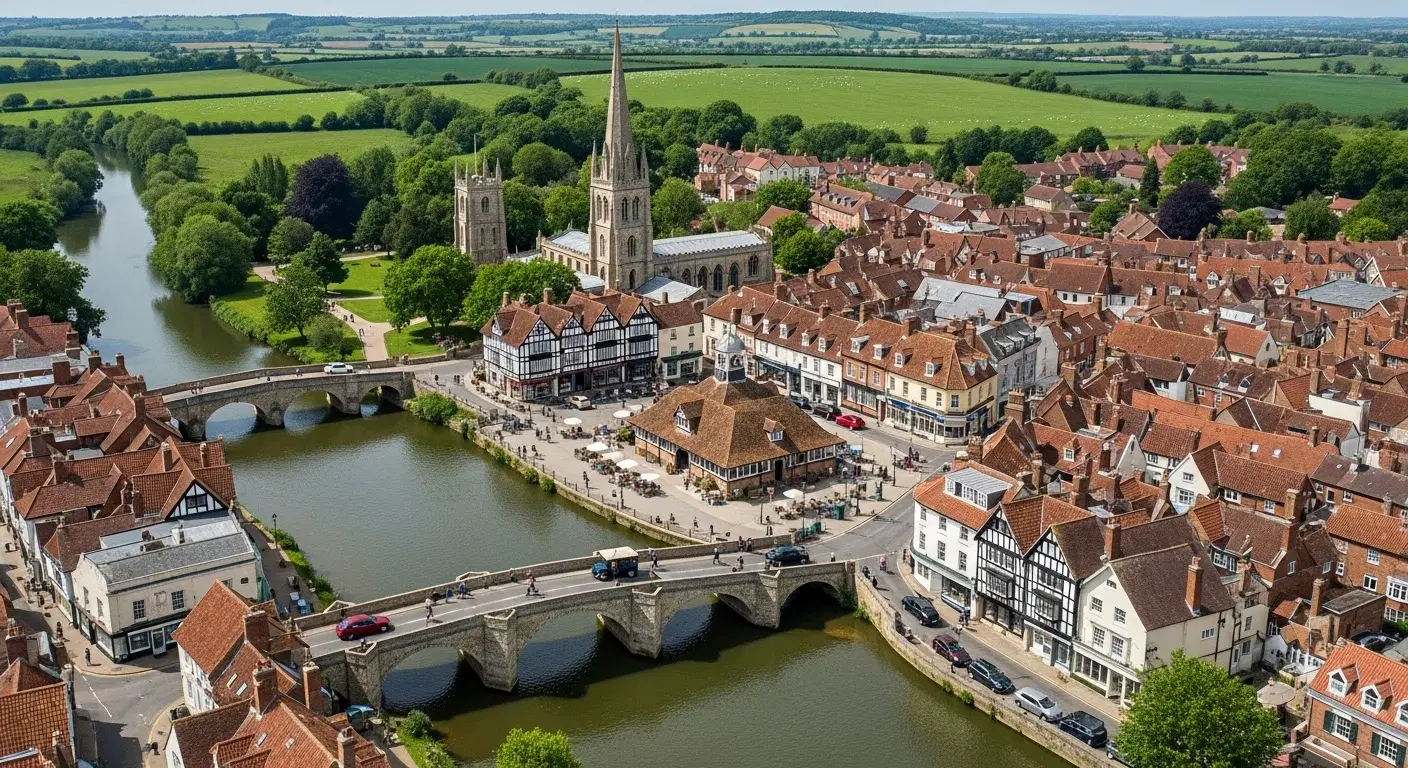
10 Things You Didn't Know About Morpeth
From a Vanbrugh-designed Town Hall and the oldest civic bells in Britain to a suffragette's grave and a football triumph at Wembley, ten surprising facts about Morpeth.
Morpeth is a handsome Northumberland market town with a long history, but even people who have lived here for years may not know all of its secrets. From a building by one of Britain's greatest architects to a football triumph at Wembley, here are ten things you might not know about Morpeth.
1. The Town Hall Was Designed by the Architect of Blenheim Palace
The bold, turreted building on the west side of the Market Place was designed by Sir John Vanbrugh, the same man who created Blenheim Palace for the Duke of Marlborough and Castle Howard for the Earl of Carlisle. Completed in 1714, the Town Hall was commissioned by the Earl of Carlisle, who was lord of Morpeth. A fire in 1869 destroyed much of the interior, but the facade was faithfully rebuilt to Vanbrugh's original design. It was restored again in 2009 at a cost of £1.1 million. Few towns the size of Morpeth can claim a Vanbrugh building.
Read more in our full guide to Morpeth Town Hall.
2. The Clock Tower Houses the Oldest Civic Bells in Britain
Morpeth's Clock Tower on Oldgate contains the oldest original peal of civic bells in the United Kingdom. The six bells were cast by Richard Phelps at the Whitechapel Bell Foundry in 1706 and have never been replaced. The tower itself was built between 1604 and 1634 from stone recycled from the ruins of Newminster Abbey. It is also one of only eight secular bell towers in England never to have been associated with a church. The bells are still rung at 8pm every evening, a tradition dating back to the old curfew.
Read more in our guide to Morpeth Clock Tower.
3. The Bells Were Meant for Berwick-upon-Tweed
Those same bells have a legend attached. They were originally commissioned for the parish church of Berwick-upon-Tweed by Major General Edmund Maine, but after the people of Berwick declined to elect him to office, Maine redirected the bells to Morpeth when he was elected as the town's MP instead. The local saying goes: "Berwick Bells are heard in Morpeth." Whether the legend is entirely accurate or partly embellished, the result is clear, Morpeth got the bells, and Berwick did not.
4. The Father of English Botany Was Born Here
William Turner, widely regarded as the father of English botany, was born in Morpeth around 1508. He was educated at the Chantry and went on to publish A New Herball (1551-1568), the first proper English-language herbal, based on original field observation rather than repetition of classical texts. Turner chose to write in English rather than Latin, democratising botanical knowledge for ordinary practitioners. The William Turner Garden in Carlisle Park is named in his honour.
Read more in our full guide to William Turner.
5. Morpeth Has One of England's Oldest Market Charters
Morpeth's market charter was granted by King John to Roger de Merlay in 1199, making it one of the oldest continuously held markets in England. The Wednesday market still takes place in the Market Place each week, over 800 years after the charter was first issued. King John may have had a complicated relationship with Morpeth, some accounts hold him responsible for the burning of the market in 1216, but the charter endured.
6. The Great Fire of 1689 Nearly Destroyed the Town
In 1689, an accidental fire swept through Morpeth and nearly destroyed the town. This was not the first major fire. The town was also set ablaze in 1215 by rebellious barons seeking to obstruct King John's military operations, but the 1689 conflagration was the most devastating. Much of the medieval town was lost, which is why the majority of buildings in the town centre date from the 18th century and later. The rebuilding created the Georgian streetscape that gives Morpeth much of its character today.
7. Emily Wilding Davison Is Buried Here
The suffragette Emily Wilding Davison, who was fatally injured when she stepped onto the track during the 1913 Epsom Derby and fell under the hooves of King George V's horse, is buried in the churchyard of St Mary the Virgin in Morpeth. Her gravestone bears the WSPU motto "Deeds not words". A funeral procession of 5,000 suffragettes accompanied her coffin through London before it was brought by train to Morpeth for burial. In 2018, a statue by sculptor Ray Lonsdale was unveiled in Carlisle Park to mark the centenary of the first women gaining the vote.
Read more in our full guide to Emily Wilding Davison.
Best for: Emily Wilding Davison's grave at St Mary the Virgin remains a place of pilgrimage for those inspired by her sacrifice.
8. The Chantry Houses a Bagpipe Museum
The Chantry, the 13th-century bridge chapel beside the River Wansbeck, is home to the Northumbrian Bagpipe Museum, the first museum in the world dedicated to the bagpipe. The collection includes over 120 sets of pipes from across Europe, including a set that belonged to King Louis XIV and a miniature set made for Queen Mary's dolls' house. Northumberland is the only English county with its own dedicated instrument, the Northumbrian smallpipes, and the museum celebrates this unique heritage. Entry is free.
9. Morpeth Town FC Won the FA Vase at Wembley
In May 2016, Morpeth Town AFC, a club from the ninth tier of English football, travelled to Wembley Stadium for the FA Vase Final. They faced Hereford FC and came from behind to win 4-1 in a remarkable performance. Chris Swailes, a 45-year-old defender, scored the equaliser with a chest-in and won the man-of-the-match award. Luke Carr, Sean Taylor, and substitute Shaun Bell completed the rout. The town staged a bus parade to celebrate, a moment of genuine sporting glory for a small Northumberland club.
10. The Village Bus Shelters Are Grade II Listed
Just south of Morpeth, the village of Stannington has a pair of Grade II listed bus shelters. They were designed by Laurence Whistler, the renowned glass engraver and architectural designer, and presented to the village by Lord Ridley in 1937 to commemorate the coronation of King George VI. The shelters stand on either side of the old A1 and are protected by Historic England as structures of architectural and historical interest. They may be the most distinguished bus shelters in Northumberland.
Best for: Stannington's Grade II listed bus shelters were designed by Laurence Whistler and gifted by Lord Ridley for the 1937 coronation.
Bonus: John Dobson Designed the Courthouse
The imposing Gothic Revival building on Castle Bank is Morpeth Courthouse, designed by John Dobson, the most celebrated architect of 19th-century North East England, responsible for much of Newcastle's Grainger Town. The courthouse was completed in 1828 as part of a larger complex that included the County Gaol for Northumberland. The gaol was demolished in 1891, but the courthouse survives as a Grade II* listed building. It cost £71,000 to build, a vast sum in the 1820s.
Morpeth is a town that rewards curiosity. Scratch beneath the surface of this quiet market town and you will find Vanbrugh architecture, Tudor science, Edwardian activism, and a set of bells that were never meant to be here.
Get in touch if you know a fact about Morpeth that we have missed.
Never miss what’s on
Join the weekly Morpeth.net digest — the best events, news and local tips, straight to your inbox. Free, one email a week.
What's On
Morpeth Wednesday Market
9:00am - 3:30pm · Market Place, Morpeth, NE61 1HG
October Quiz Night at Morpeth RFC
8:30 PM · Morpeth RFC, Grange House Fields, Mitford Road, Morpeth, NE61 1RJ
Halloween Spooktacular at Whitehouse Farm
See booking · Whitehouse Farm Centre, Stannington, Morpeth, Northumberland, NE61 6AW